LANDMARK TREATY REQUIRES DISCLOSURE BY PATENT APPLICANTS ABOUT SOURCE OF ORIGIN OF GENETIC RESOURCES AND ASSOCIATED TRADITIONAL KNOWLEDGE

“We are not simply making history but [laying] the foundation for a sustainable future for all.”
~ WIPO Indigenous Caucus
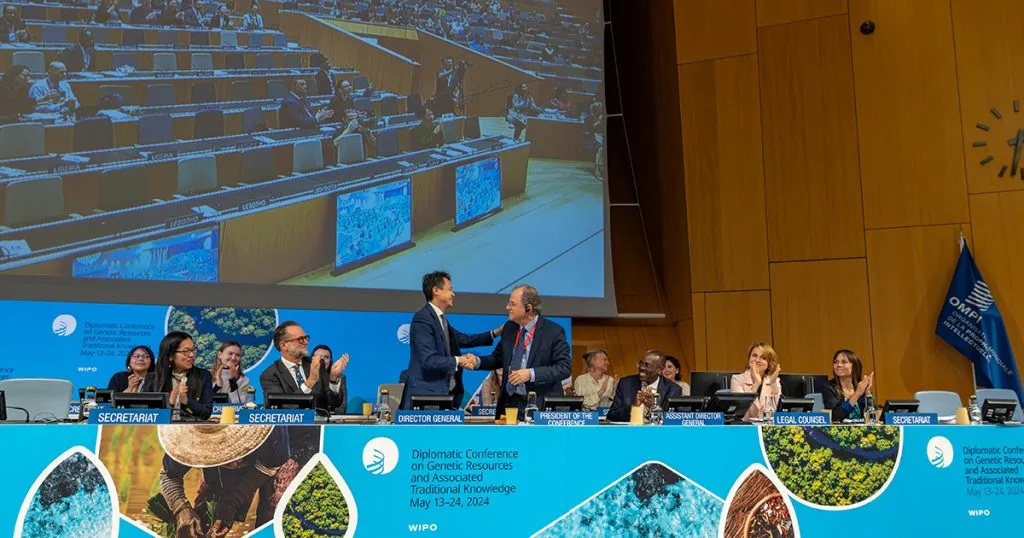
On May 24, 2024, WIPO Member States passed a groundbreaking Treaty related to Intellectual Property, Genetic Resources and Traditional Knowledge (GRATK) at the WIPO Diplomatic Conference held in Geneva, Switzerland. Genetic resources include those that are found in medicinal plants and the traditional knowledge associated with the use of such medicinal plant.
The WIPO Treaty includes a requirement that patent applicants “disclose” when their patent applications are based on traditional knowledge obtained from Indigenous People. “This is the first WIPO treaty to address the interface between intellectual property, genetic resources and traditional knowledge and the first WIPO Treaty to include provisions specifically for Indigenous Peoples,” said Makalika Naholowaa, National Native American Bar Association former president. This is a positive outcome as the status quo—nondisclosure—makes it literally impossible to even know when genetic resource patents are sought that leverage Traditional Knowledge.
[read]
Why is the WIPO Treaty important to Indigenous People?
The WIPO treaty commits Member-States to implement laws in their national patent systems that require disclosure by patent applicants of both national origin and traditional knowledge origin of any genetic resource upon which an invention is based in a patent application. The ratification of the treaty in the United States will require legislative action.
The disclosure requirement can enable inquiry into the legal standards of an invention (novelty and non-obviousness) by USPTO, which may result in the invention being deemed unpatentable. It can also enable monitoring of patent applications and advocacy by Indigenous Peoples whose Traditional Knowledge is being used. The disclosure requirement will give “tribal governments and others the notice they need to participate in processes and discussions about the treatment of their GRATK,” said Sue Noe.
What provisions in the WIPO Treaty are not helpful to Indigenous People?
First, the disclosure requirement does not require providing notice to the relevant Indigenous Peoples when a genetic invention uses traditional knowledge. Second, it does not require any one to secure Free Prior and Informed Consent (FPIC) to patenting such Genetic Resource. Indigenous People strongly advocated for inclusion of such provisions. These types of provisions are certainly consistent with human rights principles.
In addition, Ag and Pharma companies across the world successfully had a specific provision included that states that the failure to disclose will not mean loss of the patent altogether.
Much Gratitude.
Many individuals worked on this issue for two decades. NAC-SNM got involved with this issue about 18 months ago. “It’s been an incredible effort, and we acknowledge the efforts of organizations including the National Congress of American Indians, Coalition of Large Tribes, International Indian Treaty Council, National Native American Bar Association, United Nations of Oklahoma, Polecat Ceremonial Grounds, Native American Church-State of New Mexico and so many others to coordinate diplomacy at the United Nations and to make their positions known to the United States,” said Kristen Carpenter.
NAC-SNM thanks Sue Noe and Kristen Carpenter for their advocacy and diplomatic efforts to protect GRATK. We acknowledge and appreciate Jon Brady, NACNA President, for his leadership and filing comments in the USPTO docket leading up to the WIPO negotiations. The author also extends gratitude to Leathan Dayish and Terry Dayish for penning NAC-SNM’s letter to Secretaries Blinken, Raimondo, and Haaland urging the United States to “uphold the legal interests of NAC practitioners throughout the United States, Indian Country, New Mexico and Navajoland at the WIPO negotiations.” The letter was submitted in conjunction with and in support of NCAI, COLT, and the Polecat Ceremonial Grounds. “Our members are citizens of tribes, and like COLT member tribes, are committed to ensuring that indigenous cultural knowledge and practices are being preserved and shared in ways that honor ancestral wisdom,” said Leo Dayish, NAC-SNM President.
It is important that there is an Intellectual Property treaty from WIPO that—for the first time—provides an opportunity for better protection of Indigenous Peoples GRATK.
[/read]